You Cannot Brick a New World
Enterprises keep buying the stone and brick of AI — the platforms, the licenses, the models — and waiting for a new world to appear. Iqbal explained, in one line, why it will not.
By Rahul Jindal · 6 min read · May 18, 2026
“A new world comes into being from new thoughts — for worlds are not built out of stone and brick.”
Muhammad Iqbal · Zarb-e-Kalim, 1936
Read this couplet on Iqbal for All →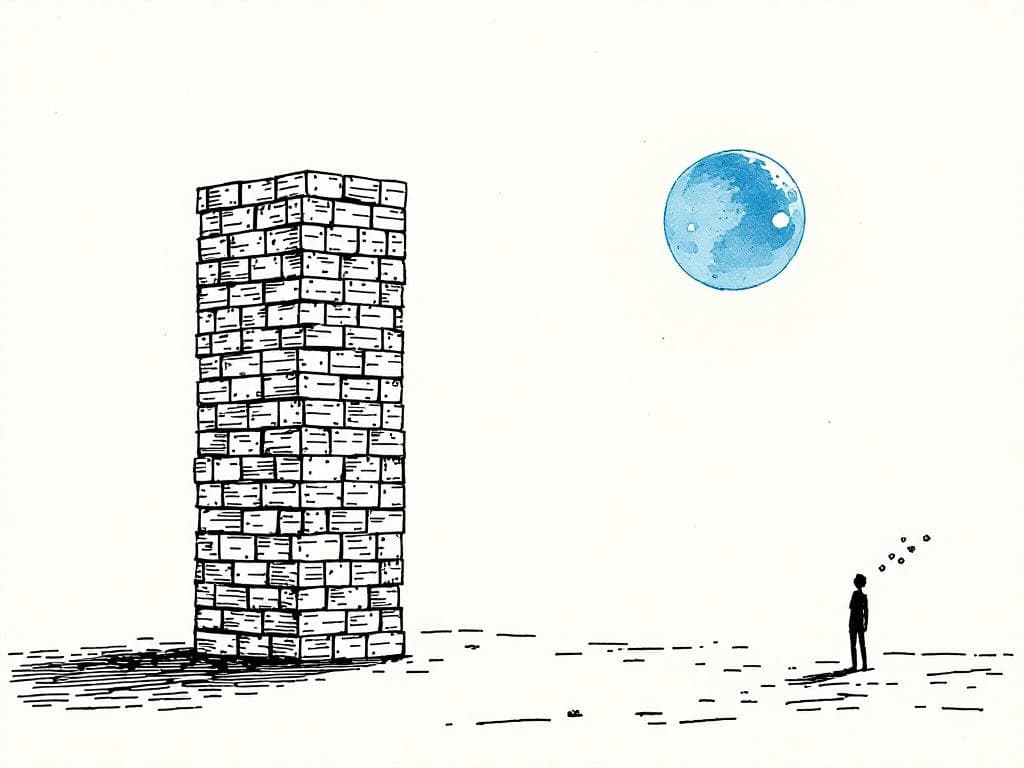
There is a question worth asking out loud in any AI program: if the technology works perfectly, what exactly becomes different? The answers usually describe stone and brick — faster processes, lower cost per task, a tool in every workflow. Useful. But Iqbal's line cuts straight through it. A new world, he says, comes from new thoughts. Worlds are not made of stone and brick.
He was making a civilizational argument: that a people does not renew itself by acquiring better material — better buildings, better machinery, even better institutions copied from elsewhere — but by thinking in new categories. The material follows the thought. It never leads it. Ninety years on, it is the most precise available description of why expensive AI transformations produce so little transformation.
Faster waste is not a new world
When an organization installs powerful new tools on top of unchanged thinking, it does not get a new world. It gets the old world, accelerated. The same processes run faster. The same decisions get made faster, by the same people, in the same shape of org. The categories — what a role is, what a team is for, where a decision sits, what good looks like — are all inherited intact. New brick, old blueprint.
This is why the enterprises with the best AI infrastructure so often show the least real change. They have been the most diligent buyers of stone. They have simply skipped the part Iqbal says is load-bearing: the new thought. And a transformation that skips the thought is not slow. It is impossible — it was never the kind of thing that could be assembled out of brick.
“An organization with unchanged thinking and powerful new tools does not get a new world. It gets the old world, accelerated.”
What a new thought looks like
A new thought, concretely, is a change in the categories an organization uses to see itself. Not 'we have an AI tool for hiring' — that is brick. But 'we no longer believe a role is a fixed bundle of tasks' — that is a thought, and an org chart cannot contain it, which is exactly the point. The thought comes first, and then the structure has to be rebuilt to hold it.
These are uncomfortable to adopt because they cannot be bought, scheduled, or delegated to a vendor. They have to be thought — by the leadership, in the open, ahead of the tooling. That sequencing is the whole of Iqbal's couplet. Afkar-e-taza — new thought — is the cause. The new world is the effect. Reverse them and nothing comes into being.
Lead with the thought
The practical correction is a sequencing discipline. Before the next platform decision, force the prior question: which of our inherited categories is this meant to overturn? If the honest answer is none — if the tool simply makes an unchanged way of working faster — then it is brick, and it should be bought as brick, with brick-sized expectations, and not be called transformation.
The transformations that create a genuinely new world are led, visibly, by a changed way of thinking — and the stone and brick are brought in afterward, to build the structure the new thought now demands. Iqbal put the order beyond doubt. Worlds are not built out of stone and brick. They are built out of what you were willing to think first.
A new operating model is born from new categories of thought, not new tools. If the thinking that organizes the work has not changed, you have not built a new world — you have re-bricked the old one.