The Storm You Should Want
Iqbal looked at a calm sea and saw something wrong with it. Most leaders look at a calm market and see something they have earned. Both cannot be right.
By Rahul Jindal · 5 min read · May 18, 2026
“May God acquaint you with some storm — for the waves of your sea carry no restlessness in them.”
Muhammad Iqbal · Bal-e-Jibril, 1935
Read this couplet on Iqbal for All →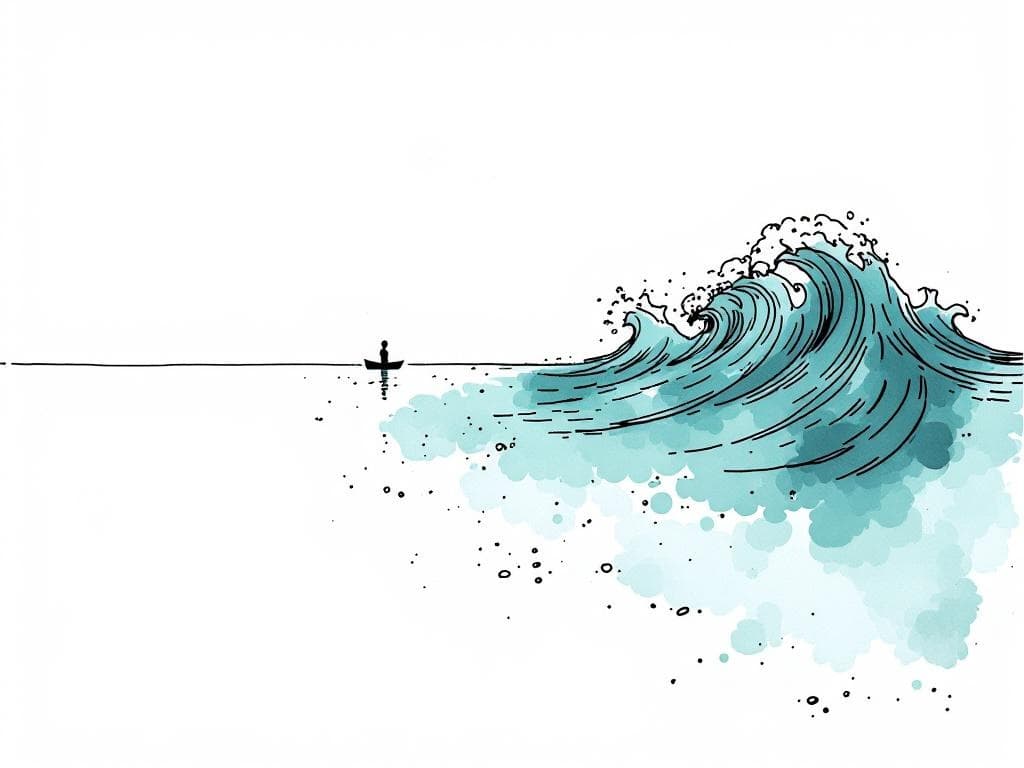
It is, on its surface, a strange thing to wish on someone. May God acquaint you with a storm. Iqbal writes it as a blessing, almost a prayer, and the reason is in the second line: the waves of your sea carry no restlessness. The calm is not peace. It is a warning. A sea without restlessness is a sea that has stopped testing itself, and Iqbal would rather you met a storm than stayed that still.
Every incumbent enterprise should sit with that line, because the modern version of the untroubled sea is the business that has had a long, profitable, undisturbed run — and has quietly mistaken the absence of a storm for the presence of strength.
Calm hides the brittle
A stable market is a flattering one. It lets a slow process look adequate, a fragile dependency look robust, a team that cannot actually change look like a team that simply has not needed to. None of these is tested, so none of these shows. The organization reads its own calm as competence.
Then the storm arrives — and a storm always arrives — and all of it surfaces at once: the brittle process, the single point of failure, the function that turns out to have no capacity to absorb change. It was all there during the calm. The calm just had no instrument for finding it. The storm is that instrument.
“A sea without restlessness is a sea that has stopped testing itself.”
AI is the storm, and it is early
For most enterprises AI is the storm, and the useful news is that it is still in its early hours. The waves are building but they have not yet broken. This is the rarest and most valuable moment a leader gets — turbulent enough to be honest, not yet violent enough to be terminal.
The instinct is to use this window to project calm: reassure the board, reassure the market, signal control. Iqbal's couplet says the opposite. Use the window to manufacture restlessness while it is still cheap — stress the operating model on purpose, break your own slow process before the market breaks it for you, run the storm as a drill while a drill is still possible.
Wanting the storm
There is a deeper point, and it is the one Iqbal actually cared about. He did not merely tolerate the storm; he wanted it, because he believed a self — a person, a people — discovers its real strength only against resistance. Comfort tells you nothing true. The same holds for an institution.
The leaders who compound through the AI cycle are not the ones with the calmest sea. They are the ones restless enough, early enough, to go looking for their own storm — and grateful, in Iqbal's exact sense, when they find it.
A market with no turbulence does not reveal what is brittle in your organization. The storm is not the threat to your operating model — it is the only honest audit of it. Want it before it arrives.