The Hard Pass
Iqbal described change resistance more precisely in two lines of Urdu verse than most transformation programs manage in forty slides — and told you why yours is stalling.
By Rahul Jindal · 5 min read · May 18, 2026
“To fear the new order, and to cling stubbornly to the old — this is the hard pass in the life of nations.”
Muhammad Iqbal · Bal-e-Jibril, 1935
Read this couplet on Iqbal for All →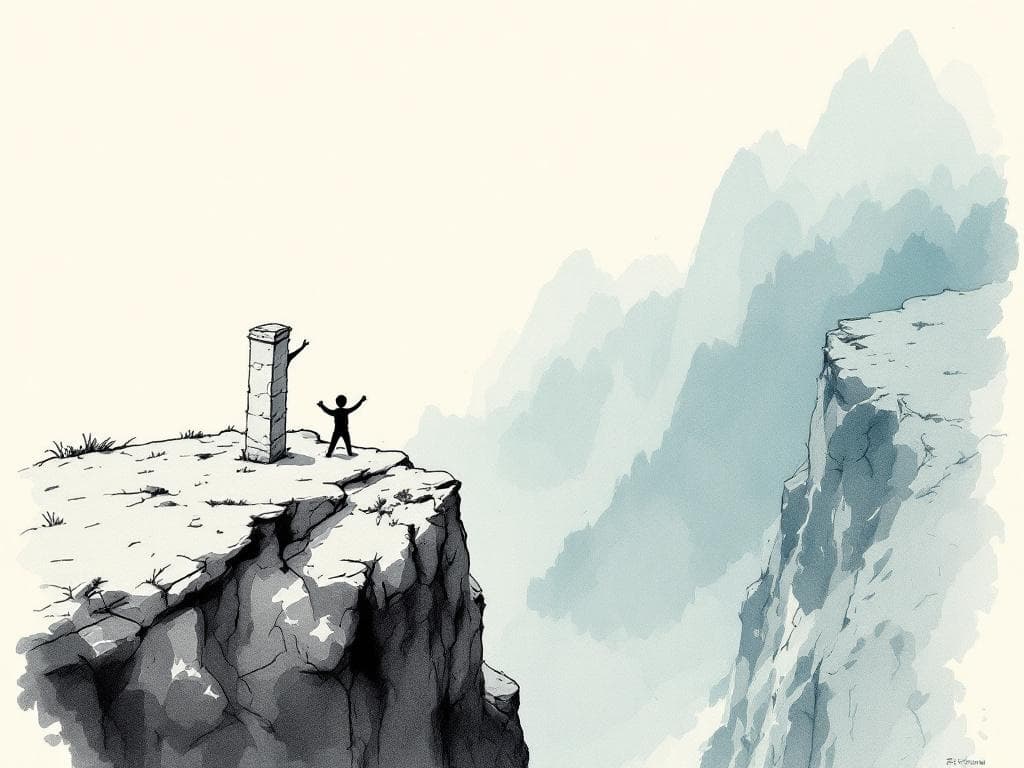
Every AI transformation I have watched stall has stalled in roughly the same place. Not at the business case, and not at the tooling — those are the parts a program is built to handle. It stalls in the quieter months afterward, when the new system is real and the old behaviour will not move. Leaders call this resistance and treat it as one problem. Iqbal, ninety years ago, in two lines of Urdu, saw that it is two.
Look at the verbs. Darna — to fear. Arna — to dig in, to cling. Iqbal sets them side by side because they are the two distinct things a person does when the ground shifts under them. Then he says something a transformation plan rarely admits aloud: this — yahi — is the hard pass. Not a detour, not a failure of the plan. The stage itself. The difficult country every renewal has to cross.
Two moves, not one
Fear of the new and attachment to the old look like the same resistance from the outside — the same stalled adoption, the same quiet workarounds, the same meeting that goes nowhere. Underneath they are opposites, and they call for opposite interventions.
Darna — fear of the new — is a calculation about risk. The person is not lazy and not nostalgic; they have run a fast, private sum and concluded the new way could expose them, fail in public, cost them standing. You answer fear with safety: shrink the first step until it is survivable, let them watch a peer go first, make early failure private and cheap. Lower the stakes and the fear has less to feed on.
Arna — clinging to the old — is not about risk at all. It is about identity and sunk cost. The old way is where the person built their competence, their relationships, their standing as someone good at the job. You cannot reassure that away, and reassurance is exactly the wrong tool. Clinging is answered with the opposite of safety: you make the cost of the status quo visible and felt, and you retire the old scaffolding so there is nothing left to grip. You answer clinging with consequence.
Run the wrong one and you deepen the problem. Pressure someone who is afraid and you have confirmed their fear. Reassure someone who is clinging and you have confirmed that the old way is still safe. Most stalled transformations are running a single intervention — usually reassurance, because it is the kind one — against a population split between the two.
“Reassure someone who is clinging, and you have just confirmed the old way is still safe.”
Diagnose before you intervene
The practical move is almost embarrassingly simple, and almost nobody does it: before designing the change plan, sort the resistance. Walk the affected population — team by team, name by name — and ask one question. Is this fear of the new, or attachment to the old? The two are indistinguishable in a survey. They are obvious within a minute of conversation.
And they rarely spread evenly. Fear pools in the people with the least cover — the junior, the newly promoted, anyone whose competence is still on trial. Clinging pools in the senior and the expert — the people whose authority is built on the system you are replacing. Which means the resistance most dangerous to your transformation is usually sitting in your most experienced people, and it is not fear. It is arna. And every reassuring email you send sails straight past it.
Why read a poet for this
Iqbal was not writing about software, or org design, or adoption curves. He was writing about whether a civilisation could renew itself or would harden into its own monument — the question that occupied his whole life. But the structure he found is scale-free. A nation, a company, a function, one person at a desk on a Monday: each meets the hard pass, and each either names the two moves and answers each in its own currency, or stalls in the country between the old world and the new.
He also refused the comfortable lie. He did not say the hard pass could be skipped, or charisma'd around, or waited out. Manzil yahi kathin hai — this, precisely, is the difficult stage. The most useful thing a transformation leader can do with that line is stop being surprised by it. The hard pass is not a sign your change is failing. It is the change. Everything before it was preparation.
Resistance is two moves, not one — fear of the new, and attachment to the old. Diagnose which you face before you intervene: the cure for each is the other's poison.