The Human Margin: Where White-Collar Jobs Actually Live
By Rahul Jindal · 14 min read
If you do knowledge work, you have run the calculation in your head. The AI can write the memo, build the model, draft the code. So at some point it does your job, and at some point after that, someone notices. By spring 2026 the fear had numbers behind it. The outplacement firm Challenger, Gray & Christmas reported AI as the single most-cited reason for announced job cuts, two months running. The CEO of Anthropic had already said out loud that AI could erase half of all entry-level white-collar jobs within five years.
You will be offered two answers to this fear, and both are wrong. The optimist says technology always creates more jobs than it destroys, so relax. The doomer says this time the machine does everything, so despair. They sound like opposites. They share a mistake. Both think the question is about tasks. The optimist bets humans always find new tasks; the doomer bets the machine takes all of them. The question was never about tasks. It is about two margins, and once you see them, the future of your job stops being a slogan and becomes something you can read.
Where a Job Actually Comes From
A job is not the same thing as work. Work is any task worth doing. A job is the decision to pay a specific human to do some of it. The gap between those two ideas is where this entire debate has been hiding.
Picture two lines.
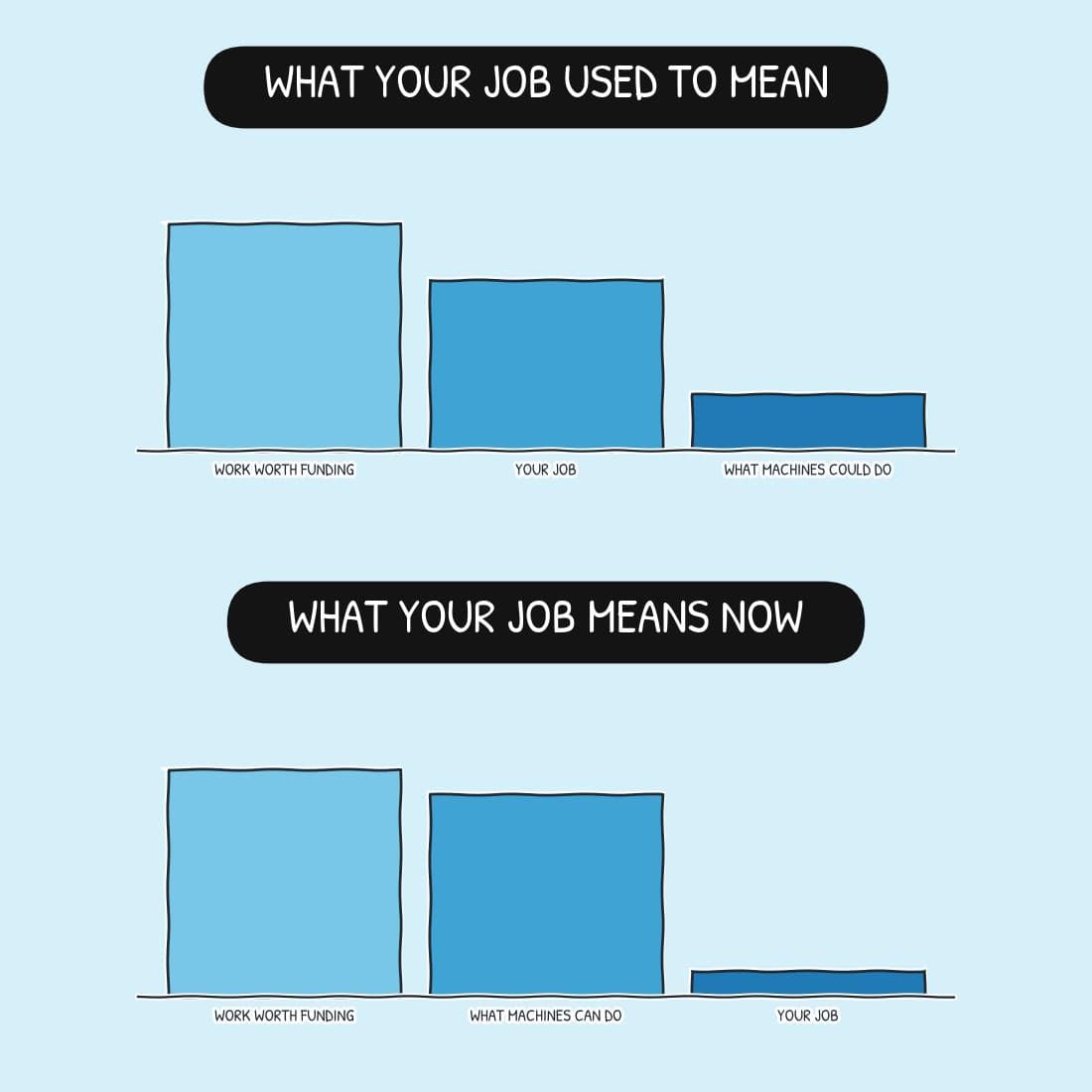
The first line is the work an organization is willing to fund. Call it the demand line. Here is the part most people get wrong: this line is not fixed. It rises, continuously, because organizations manufacture work. There is no fixed lump of work to be divided between humans and machines. The supply of work an organization can find for itself is, for practical purposes, unlimited.
The second line is the cost of the cheapest acceptable way to do a unit of that work. Call it the frontier. For any task, you can use a human, or a machine if the machine clears the quality bar for less. The frontier is the price of the cheapest option that is good enough.
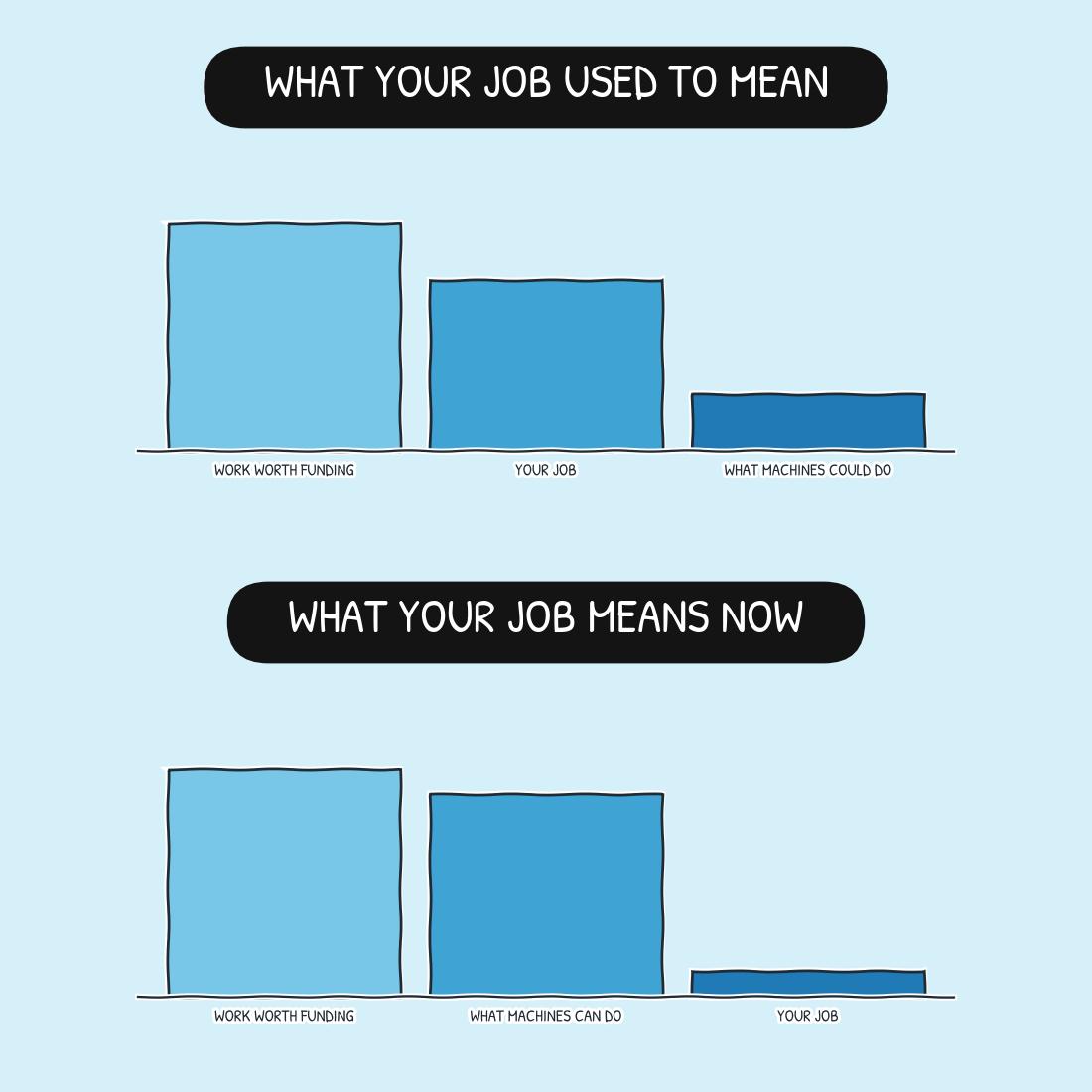
A human job lives in the band between these two lines: the work that is worth funding, and that a human is still the cheapest acceptable way to do. That band is the human margin. It is not a metaphor. It is the actual space your paycheck occupies. Everything that follows is about what happens to that band.
“A job lives in the band between the work worth funding and the work a machine can do well enough for less. That band is the human margin. The whole question is whether it is widening or closing in your corner of the economy.”
The Engines That Manufacture Work
The reason the human margin has never closed before, through two centuries of automation, is that the demand line keeps rising. Organizations are machines for generating work. Strip one to its mechanics and almost all of its work comes from three engines.
Goals. The company sets a goal, breaks it into department goals, breaks those into team goals and tasks. The breakdown is never clean, so the seams between the cascaded goals generate their own work: the reconciling, the realigning, the meeting about why one team built what another did not need. Call it the alignment tax. It is the unavoidable cost of cutting one big goal into many smaller ones and handing them to different people.
Innovation. Every part of the company tries to find a better way: a better product, a better process, a better bet. This engine has no natural ceiling. There is always another experiment to run.
Supervision. Work has to be watched. Reviews, approvals, governance forums, audit, risk, compliance, and a person who is accountable. The bigger and faster the company, the more of this it needs.
Each engine runs without a natural limit. There is always another goal to cascade, another experiment to run, another thing to check. This is why "AI can do my tasks" has never been enough to end a career on its own. As fast as the machine clears the work in front of it, the engines manufacture more. So far this is the optimist's story, and if it were the whole story, you could relax. It is not the whole story, because the engines are not the only thing moving.
The Frontier Does Not Sit Still
Here is what the optimists miss, and it is the reason "this time is different" deserves a hearing rather than a dismissal.
In every previous wave of automation, the machine took a fixed band of tasks and stopped. The loom did not learn to design clothes. The spreadsheet did not learn to decide what to model. The frontier moved once, humans stepped up to the work above it, and it held there for a generation. The comfortable phrase "machines do the routine, humans do the judgment" worked because the line between routine and judgment stayed put.
It is not staying put now. The defining feature of this technology is that the frontier climbs. Five years ago the human side of the line included writing, coding, and analysis. Those are now substantially on the machine side. The work we currently call the human redoubt, deciding, designing, judging, overseeing, is simply where the frontier happens to sit today. No law of nature fixes it there. Anyone who tells you judgment is permanently human is making the same bet the optimists made about writing in 2020, and they may lose it the same way.
This is the steelman the doomers deserve, and the lump-of-labor reply does not answer it. Saying "automation has always created new work" describes a world where the frontier moved once and stopped. It says nothing about a world where the frontier climbs every year. The honest position is that we do not know how high it climbs, or how fast. So do not anchor your career to a task you believe a machine cannot do. Anchor it to the race between the two lines.
“Anyone who tells you judgment is permanently human is making the same bet the optimists made about writing in 2020. The human side of the line is not a fortress. It is wherever the frontier happens to sit this year.”
The Race, Not the Verdict
Your job is the local outcome of a race between two lines. The demand line rises as the engines manufacture work. The frontier rises as the machine climbs. Whether the human margin in your niche widens or closes depends on which line rises faster where you stand. That is why there is no single answer to "will AI take the jobs," and why anyone offering one is selling something.
The race resolves differently in different places, and the difference is not random. Two things decide it.
The first is elasticity: how fast the demand line rises in your niche. When the work gets cheaper, does anyone want more of it? For some work, yes, without limit. Cheaper software means everyone wants more software. Cheaper analysis means more questions worth asking. The demand line races upward and stays ahead of the frontier. For other work, no. There is a finite number of invoices to process, expense reports to audit, standard contracts to review. When that work gets cheaper you do not want more of it; you want it cheaper. The demand line is flat, the frontier climbs into it, and the band closes. The roles being cut today are overwhelmingly the inelastic ones. That is not a coincidence. It is the mechanism.
The second is how fast the frontier climbs in your niche.Some work sits close to the machine's reach and will be crossed soon: structured, high-volume, judged against a clear right answer, with the training data sitting right there in the logs. Other work sits further up: genuinely novel problems with no precedent to learn from, work where being wrong is catastrophic so the bar for "acceptable" is brutally high, and work whose entire point is that a human is accountable for it. That last category is real but narrow. Accountability needs one responsible person, not an army of reviewers, so it protects a few necks, not a department.
So the map is not "safe jobs" and "doomed jobs." It is a race you can handicap.
Four Corners of the Human Margin
Put the two forces on two axes. How elastic is demand for your work, and how fast is the frontier climbing toward it. You get four corners, and almost every white-collar role is a blend of them, task by task.
Elastic demand, slow-climbing frontier
Cheaper output creates demand for more of it, and the machine is far from reach. Net-new products, frontier research, complex advisory with no precedent to copy. The engines manufacture work above the line faster than AI can climb to it. The band widens.
Elastic demand, fast-climbing frontier
Demand grows, but the machine is arriving fast. Software, content, analysis. The work multiplies and gets cheaper at the same time. You hold a job here only by staying ahead of a frontier that is actively chasing you. Growth and pressure at once.
Inelastic demand, slow-climbing frontier
No new work is created when it gets cheaper, but the machine cannot reach it yet. High-stakes accountable judgment, heavily regulated decisions, bespoke work where being wrong is catastrophic. Stable, not growing, and it closes the day the frontier climbs in.
Inelastic demand, fast-climbing frontier
No new work, and the machine is already at the door. Routine processing, standard contract review, expense audit, level-one support, structured back office. Cheaper does not mean more, and the frontier has arrived. These roles fall first, and they are falling now.
The honest unit of analysis is the task inside the job, not the title on the door. Most roles hold tasks in more than one corner. The career question is which corner your time is drifting toward.
The Second Margin
Everything so far decides whether a human is the cheapest acceptable way to do the work. It does not decide whether the work gets funded at all. That is the second margin, and it is the one I have written about as the Margin Thesis.
A widening human margin is only a job if the company has the financial margin to pay for it. And AI is now a direct claimant on that financial margin. Roughly four trillion dollars is committed to AI infrastructure through 2030, carrying a depreciation clock that has to be recovered from somebody, and it travels down a chain that reaches the enterprise as higher software prices. Microsoft is raising the price of its core productivity suite. Vendors across the category are adding per-action and per-conversation fees. The total AI bill keeps climbing even as the price per unit falls, because cheaper units invite far more units. Meanwhile, by an MIT count in 2025, roughly 95 percent of enterprise AI pilots had produced no measurable return yet. So the same company funds the AI and still funds the people, and the AI bill competes with payroll for one pool of margin.
This is where the optimist and the doomer each ignore a fact. The optimist assumes the productivity shows up and pays for everyone. The doomer assumes the cost shows up and pays for no one. The truth is a timing mismatch. The cost lands now, on this year's income statement, while the productivity, if it comes, lands later. In the gap between the two, real budgets get cut, and they get cut even where the human margin is wide and the work is worth doing. A company under margin pressure does not run a careful task-by-task analysis. It cuts the largest addressable cost it has, which after real estate and technology is people, and it cuts the discretionary engines first: innovation and oversight, the exact two that widen the human margin most.
So your job sits at the intersection of two margins. The human margin decides whether a person should do the work. The financial margin decides whether the company will pay for it. Both are being compressed, and a job has to survive both.
“The human margin decides whether a person should do the work. The financial margin decides whether the company will pay for it. Both are narrowing, and your job has to survive both.”
But Isn't It a Bubble?
The sharpest objection to all of this comes from the people who price companies for a living. The valuation scholar Aswath Damodaran has called the current AI frenzy a textbook case of what he and Bradford Cornell named the Big Market Delusion. When a market looks vast enough, every entrant assumes it will be the one that captures it, so the entrants end up collectively overpriced. The market can turn out to be every bit as large as promised and the firms chasing it can still disappoint together, because each one banked on a share that all of them cannot have. By his arithmetic the AI industry needs something like two to four trillion dollars of eventual revenue to justify what is being spent to build it, and the headline projections sit far above that. If he is right, the boom is mispriced.
Read quickly, that sounds like relief. If the AI build-out is a bubble, surely the pressure on your job is imaginary too. It is not, and the reason is the single most important thing to hold onto here. Damodaran is making a claim about valuations, not about labor. He is saying the basket of AI companies is too expensive for an investor to buy. He is not saying the technology is weak, or that the bill goes away. Those are two different questions, and they come apart.
Here is why the bill travels even when the valuations are wrong. The four trillion dollars is not a forecast waiting to be confirmed. It is committed. The data centers are going up, the chips are bought, and the depreciation clock is already running. Money that has been spent has to be recovered from someone, and a disappointed investor does not hand the cost back to the enterprise as a refund. The reverse happens. A vendor that overspent and now has to show a return prices harder, not softer, because its own margin is under exactly the pressure this essay describes. The bubble and the squeeze are not alternatives. The fiber-optic build-out of the late nineties was a bubble that wiped out the investors who funded it, and it still laid the cable that displaced a generation of telecom work. A bursting bubble destroys the people who paid for it. It does not un-build what their money built, and it does not refund the cost to your employer.
“A bursting bubble destroys the people who funded it. It does not un-build what their money built, and it does not refund the cost to your employer.”
So the skeptic and I agree on more than it first looks. The AI basket may well be overpriced. Some of the companies drawing themselves on a slide today will not survive their own forecasts. None of that reopens the band your job lives in, because the financial margin is squeezed by the bill that was committed, not by the valuation that was promised. Watch the spending, not the stock price. The spending is what reaches your budget.
So, Will It Take Your Job?
The honest answer has three parts, and not one of them is "it depends on whether AI can do your tasks."
It depends on elasticity. Are you doing work where cheaper means more, so your own output pulls more work toward you, or work where cheaper just means cheaper and the savings are the whole point.
It depends on the frontier's speed where you sit. Structured, high-volume work with a clear right answer and a trail of training data will be crossed soon. Novel, high-stakes, accountable work will be crossed later, and some of it not for a long time.
It depends on your company's financial margin, which is the part you do not control and most need to read. A capable worker in a margin-squeezed, no-pricing-power business is more exposed than a mediocre one in a fat-margin business, because the budget that funds the job is set above the level of individual talent.
The move follows from the map. Do not try to out-run the frontier on the work it is climbing toward; on a long enough timeline you lose that race. Move toward elastic work, where your output creates demand for more of itself, and toward the slowest-climbing part of the frontier: novel problems, high-stakes judgment, and the accountable decisions a company will always want a human to own. Not because a machine can never do them, but because the band stays open there longest, which is all anyone has ever really had.
What Would Prove This Wrong
A thesis that cannot be wrong is worthless, so here is the prediction this one makes. The two-margins model predicts divergence. White- collar work does not rise or fall as a block; it splits, and the split tracks elasticity and frontier-speed, not raw task automatability. Inelastic, structured, data-rich roles should show employment and wage decline first and clearest. Elastic and high-accountability roles should hold or grow. If instead we see uniform decline across all knowledge work regardless of niche, this model is wrong and the doomers are right. If we see uniform resilience, this model is wrong and the optimists are right. The early signal, routine and entry-level roles falling first while frontier and oversight roles grow, is consistent with divergence. But it is early, and that is the condition that would change my mind.
Two Margins, One Question
There are two forces that decide the future of any white-collar job, and they are a matched pair. The human margin is whether a person is still the cheapest acceptable way to do work worth doing. The financial margin is whether the company has the money to fund it once AI has taken its cut. The first is compressed by a frontier that climbs. The second is compressed by a bill that travels. Your job lives in the overlap.
This is why the fear is both real and badly aimed. It is real because both margins are genuinely narrowing, and for inelastic work below a fast-climbing frontier in a thin-margin company, the band can close completely, and no reassurance about the history of automation will reopen it. It is badly aimed because it treats the outcome as already decided, when it is a race you can read and, to a degree, position for. The work does not vanish; the engines see to that. What moves is the frontier, and what gates it is the margin. Stop asking whether AI can do your tasks. Start asking whether the work above the frontier is being manufactured faster than the frontier climbs in your corner of the economy, and whether your employer has the margin to pay for it. That is the question. Everything else is a slogan.
Which corner is your work in?
Twelve questions, about four minutes. The Human Margin Diagnostic places your work on the two axes, tells you whether your employer can afford to fund it, and gives you the one move that matters most from here.
Take the Human Margin DiagnosticEmail this as a LinkedIn pack
Get a feed-ready LinkedIn post (under the 3,000-character cap), a long-form LinkedIn article version, the hero image, and an editable document version of the full essay, delivered to your inbox. Ready to post.
Related Insights
The other margin
The Human Margin decides whether a person should do the work. The Margin Thesis decides whether the company can afford to fund it. Two margins, one job.
Read The Margin Thesis