Where Is Your Gravity?
What the org actually orbits around, and why it almost never matches what leadership says.
By Rahul Jindal · 8 min read · Published May 12, 2026
A senior new hire joins. The CEO welcomes her in all-hands, names the strategic priority, and says the company is “pivoting toward it.” She is energized. She believes the pitch. She joined for it.
By week three she has noticed something. The work that gets quoted in the next exec email is not the strategic priority. The senior hires landing in adjacent functions are not landing in hers. When two priorities collided in her first cross-functional meeting, the strategic one lost. She does not say anything. She is too senior to be the person who raises it. She starts learning how things really work here.
By month nine she has resolved her internal cognitive dissonance the only way an experienced operator can. The pitch is one company. The gravity is another. She picks which one to spend her career on, and almost always picks the gravity, because the gravity is what actually decides her scope, her promotions, her review, and her resources. The pitch was a hiring tool. The gravity is the institution.
“The pitch was a hiring tool. The gravity is the institution.”
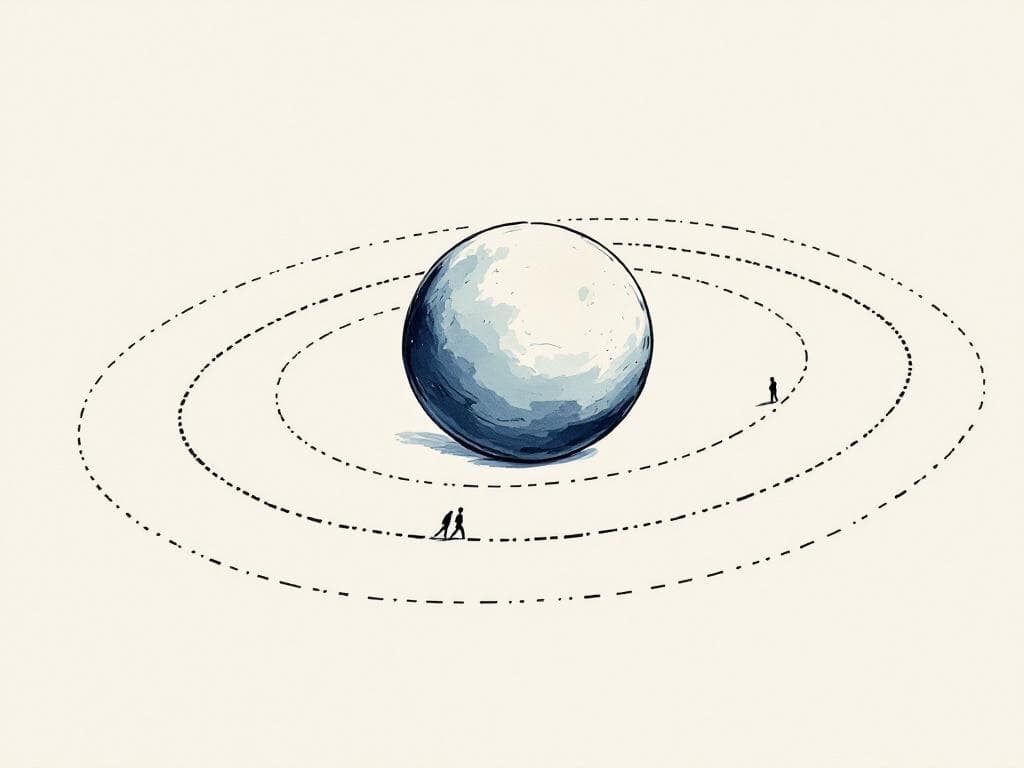
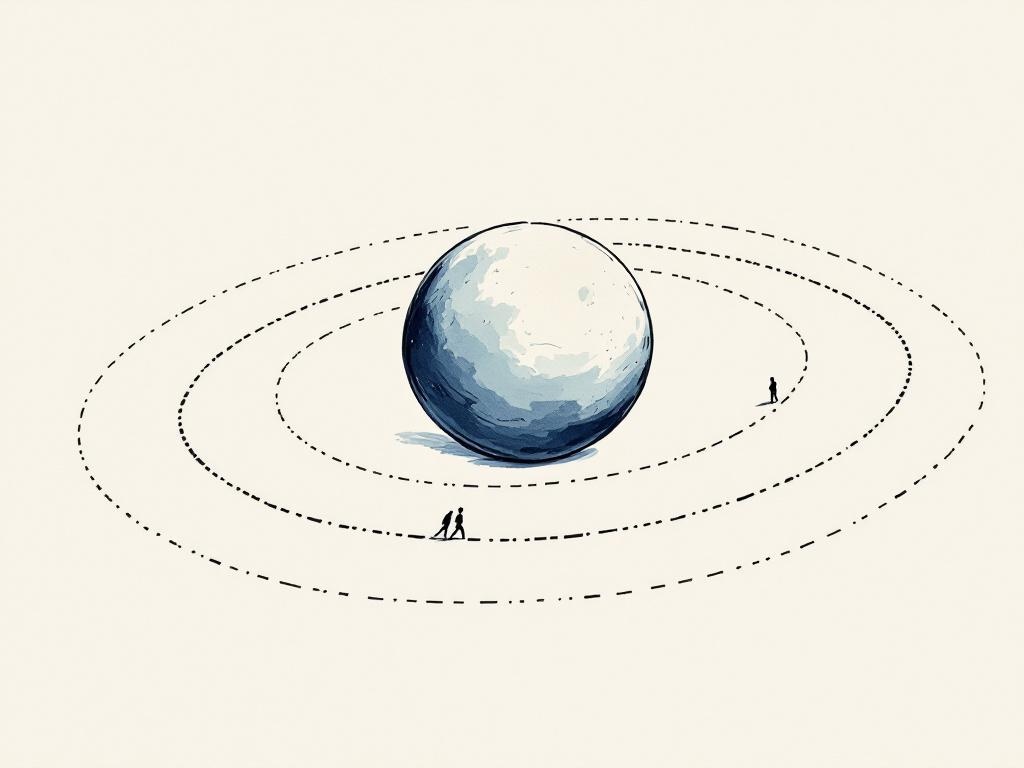
Every organization has a center of gravity. It is what the work actually pulls toward, regardless of what the strategy says. Mass settles where status, attention, decisions, and money concentrate. The chart on the wall shows reporting relationships. The gravity shows what is actually true. The two can diverge for years before anyone names the divergence, and during those years the talent the strategy depends on is being asked to operate inside an institution it does not believe in.
In a regulated incumbent moving on a five-year clock, gravity drift is a manageable problem. In an AI-era company moving on a two-year clock, gravity drift is the failure mode. Talent now reads gravity in the first month, not the third year. Smaller teams mean each senior hire is structurally more exposed to the gap. Decisions pushed to the edge of the work mean the edge has to share the same gravity as the center. If the edge is orbiting one strategy and the center is orbiting another, the speed advantage AI is supposed to confer turns into operational drag.
What gravity actually is
Behavioral physics is not a metaphor. Status hierarchy is the operating system of every organization, and the operating system is what determines what runs. If customer-facing work is low-status, no number of customer-obsession posters can make the work happen. If engineering excellence is the highest-status thing, the company will out-execute its peers regardless of whether the strategy says it should. The status hierarchy is the gravity, and the gravity is what wins when two priorities collide.
You can measure gravity in three observable signals. Each one is auditable. None of them require a survey.
Apex: what sits at the top
Scan the last twelve weeks of all-hands transcripts and exec emails. Whose work gets quoted by name? Where are the recent senior external hires landing? When the company faced a genuinely hard decision in that window, who got the invite into the room?
The pattern is the answer. If senior hires are concentrated in legacy or maintenance functions while the strategy says the work is somewhere else, the apex of the organization is misaligned. If the same three or five names appear in every hard-decision conversation regardless of which function owns the decision, the apex is closed. If the quote rotation always lands in the same one or two functions, the work the company actually values is the work those functions do, regardless of what the deck says.
Orbit: what the cadence rotates around
Which function defines the operating cadence? Who owns the weekly review structure, the KPI definitions, the escalation paths? When two priorities collide at the operating level, which one wins by default without escalation? When budgets are cut, what gets cut last? When they expand, what gets expanded first?
Cadence ownership is the most underweighted question in organization design. The function that owns the cadence sets the gravity, because the cadence is what the rest of the organization plans against. If finance, legal, or compliance defines the cadence while the strategy depends on engineering or product, the strategic function is structurally downstream of the legacy gravity. Strategy decks change quarterly. Cadence changes once every several years. The cadence wins.
Drift: the gap itself
Drift is the honest axis. It asks whether the stated strategy and the observed gravity are the same institution, or two different ones. The cleanest single test: can a new hire correctly identify what the company actually values within ninety days, and does it match the stated strategy? If new hires sense the gap but learn to navigate it silently, drift is high and the institution is leaking credibility quietly. If new hires explicitly hear, in onboarding, “here is what we say, here is what is actually true, here is how we are closing the gap,” drift is low and the institution is operating with rare honesty.
Two harder tests for drift. First: in the last twelve months, has anyone been promoted for explicitly working against the stated strategy? If yes, the counter-strategy is the actual gravity, and the strategy is a rhetorical layer. Second: does the mission's altitude match the shape's altitude? Grand mission inside a small shape leaks credibility. Small mission inside a grand shape leaves the best people on the table. Both gaps are visible to senior talent, even when they cannot name what they are seeing.
The structural-promise audit
The most important consequence of gravity drift is the most-easily-missed: every emotional promise the company makes implicitly carries a structural promise underneath, and the structure is what makes the promise honest. If a company preaches ownership but centralizes decisions, the promise is fake. If it preaches speed but routes every change through six committees, the promise is fake. If it preaches customer obsession but the customer-facing function is structurally downstream of every other function, the promise is fake. Audit the structure, not the language. The structure is the gravity. The language is the pitch.
The drift between language and structure is where the most senior, most discerning talent reads the company. They will not raise it. They will not write a Glassdoor review about it. They will quietly route their best work to another opportunity, and the company will lose the people it needed most without ever knowing why.
Why the AI era amplifies drift cost
Three structural shifts make gravity drift more lethal in the AI era than it was in the breadth era.
First, teams are smaller and more senior. The breadth-era buffer (a 200-person organization can absorb a misaligned hire) does not exist in an AI-era team of twelve. One miscalibrated senior is a structural problem at twelve, not a manageable variance.
Second, decisions push to the edge of the work. In a breadth-era hierarchy, the gravity could live at the top and the edge could comply. In an AI-era organization where the institution explicitly wants decisions made at the edge, the edge has to share the same gravity as the center. If they do not, the edge makes decisions optimized for the wrong thing at machine speed, and the institution discovers the mismatch only when the cumulative drift surfaces a quarter or two later.
Third, talent now reads gravity in the first month, not the third year. Onboarding cadences are compressed. Senior practitioners have more options than they have had in any prior cycle. If they read the gap in week two, they will not stay through year two waiting for the structure to catch up. Time-denominated promises and structural drift are two faces of the same governance failure.
The diagnostic
CoG is the self-scored audit of behavioral physics. Three axes (Apex, Orbit, Drift), nine questions, four-level maturity scale per question, and a seven-item antipattern checklist that caps individual axes when structural fakery is admitted. Tier-calibrated. The output is a number, a verdict on how coherent your gravity is with your declared strategy, the antipatterns flagged in your structure, and the single bottleneck axis to fix next.
CoG is one leg of a triptych. RADAR audits whether the AI shape inside the company is real or performative. FGKDaudits whether the people machine is fit for the AI era. CoG measures where the org's center of gravity actually sits versus where the strategy claims it should. Together they map the structural reality of an AI-era institution: tech shape, talent shape, and behavioral physics, each measured against the strategy the company has declared.
Map your org's center of gravity against the strategy you have declared.
Nine questions, about four minutes. You will get a tier-calibrated coherence score, the antipatterns flagged in your structure, the bottleneck axis to fix next, and a verdict you can quote in a board meeting.
Start the CoG DiagnosticThe closing test
The most useful exercise after taking the diagnostic is the simplest. Ask the three most recent senior hires what they think the company really cares about. If they all give you the same answer and it matches the strategy on the wall, your gravity is coherent. If they give you three different answers, your drift is high and the institution is fragmenting at the perception layer first. If they give you the same answer and it does not match the strategy on the wall, you have a different problem: the gravity is consistent, but it is consistently aligned with something other than what leadership says is true.
Where the company spends its mass is where the company actually is. The CHRO who learns to read this signal first, and design against it, will be the one who builds the institution worth defending. The institution is the moat. The gravity is the institution. Everything else is the pitch.
Companion essay to The Last Moat. CoG is the third leg of the AI-era People Operations triptych, alongside RADAR and FGKD.
Email this as a LinkedIn pack
Get a feed-ready LinkedIn post (under the 3,000-character cap), a long-form LinkedIn article version, the hero image, and an editable document version of the full essay, delivered to your inbox. Ready to post.