The Last Moat
Find. Grow. Keep. Deploy. Rewritten for the AI era.
By Rahul Jindal · 9 min read · Published May 10, 2026
Jaya Gupta argues the institution is the next great moat. She is right. The follow-on question, the one those of us in People Operations have to answer, is who builds the institution.
The answer is uncomfortable. For a long time, HR has been organized to serve the company that already exists. Hiring loops were calibrated against last year's job ladders. Comp bands moved with last year's market. Promotion cycles followed last year's headcount. The function was designed to reduce variance, and it succeeded.
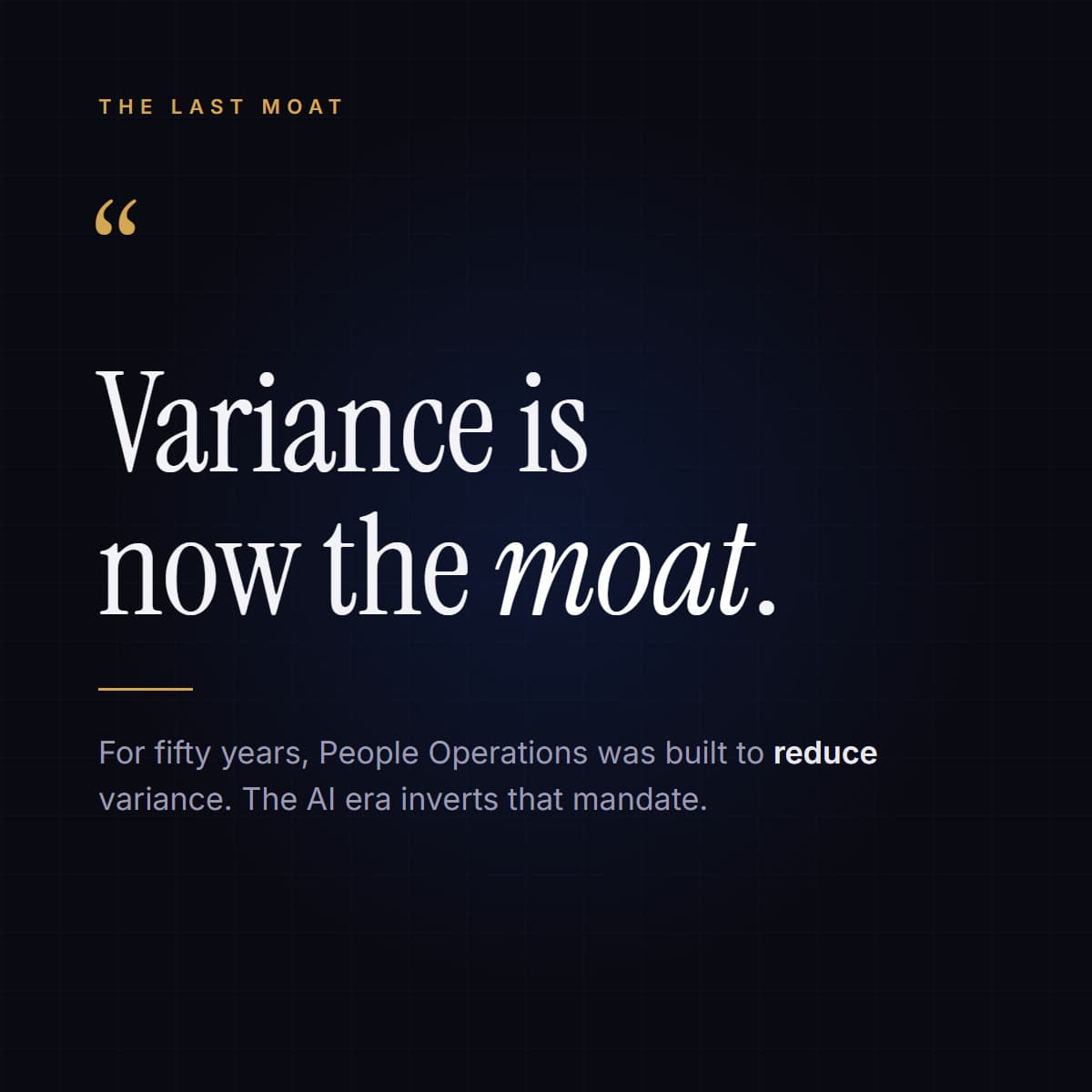
“Variance is now the moat.”
In the AI era, products commoditize inside two release cycles. Categories rename themselves between board meetings. The visible parts of company-building can be cloned by a competent ten-person team with the right model access. The only thing that compounds is the institution underneath. And the only function whose entire mandate is to design that institution is the one most companies have asked to operate it instead.
This is a claim about scope, not status. People Operations does not become important because we say so. It becomes important because the input that scales has changed. It is no longer code, capital, or compute. It is the small number of humans who can do work the company could not have done before they arrived, inside an organizational shape that lets them keep doing it.
Find. Grow. Keep. Deploy. Four verbs that govern the talent lifecycle. All four now mean something different.
Find: thesis-fit, not skills-fit
Find used to be matching. Degree, skills, experience, references. In a 5,000-person company hiring 800 people a year, matching at the resume layer was efficient. In a 200-person AI-era company hiring 30 people a year, matching at the resume layer is malpractice.
Those 30 humans will define what the company becomes. The hiring loop has to test something the resume cannot: whether the candidate holds a real, independent view on the bet the company is making about what AI will do in this category. The clearest evidence of that view is the candidate being able to say precisely where they would disagree with it. Agreement is easy to offer and reveals little; specific, well-reasoned disagreement is far harder to produce without having genuinely thought the question through. Thesis-fit, not skills-fit. Companies still optimizing their hiring funnels for throughput in 2026 are the ones whose teams will look generic in 2028.
The first audit question for a People Operations team is therefore not about diversity, time-to-hire, or quality-of-hire as currently measured. It is whether the company has a written AI thesis sharp enough that a candidate could read it and disagree. If the thesis was authored by communications instead of the operator running the work, the hiring loop is testing the wrong thing.
Grow: structural participation, not titles
Grow used to be a ladder. Title. Comp. Occasional scope expansion. Every two to four years. The ladder assumed teams grew, that managing more people was the natural promotion, and that the company would always have a place for you to inherit as it scaled. None of those assumptions survive in the AI era.
Teams stay small on purpose. The most senior practitioner's output is multiplied by tools, not by direct reports. The institution's economics start to look more like a partnership than a corporation. Growth in the AI era is structural participation. Scope, authority, decision rights, and economic upside become four separate currencies, each able to move on its own clock. The HR system that only speaks comp-and-level looks the way single-tier accounting looks today.
Jaya draws the cleanest line through this with two words: chosen versus seen. Being chosen is emotional. Being seen is structural. People who are chosen but not seen leave. The HR governance question is whether your structure can make potential visible without requiring the high performer to argue for it.
Keep: written mechanisms, not trust-me
Keep used to be retention programs. Surveys. All-hands. Manager training. Occasional grants. Most of it was designed to make people feel chosen. The AI-era retention compact is sharper.
Every “trust me, the structure will catch up” is a governance failure waiting to happen. Time-denominated promises are the most dangerous kind because time does not announce itself as it leaves. The job of the HR function is to convert each of these into a written mechanism with a date, and to run a quarterly audit that surfaces the ones that have not been honored. This is the inversion that matters: retention stops being a culture initiative and becomes a contract-enforcement function. The CHRO becomes the institution's structural conscience.
Deploy: talent to the work, not the org chart
Find, Grow, and Keep get the right people in and hold them. None of it matters if the person cannot reach the problem that needs them. Deploy used to be staffing: a headcount plan, a reorg, a quarter of negotiation to move someone across a boundary. In the breadth era that friction was survivable, because any single person mattered less. In the AI era, where a handful of people carry most of the value, leaving the right expert stranded one org-chart away from the highest-value problem is the whole game lost quietly.
Deploy is the structural ability to move scarce people, and the expertise locked in their heads, to where the value is, at the speed the work demands. It has three failure modes a People Operations team can audit directly. Talent that cannot cross a team boundary without a reorg. Knowledge that gets re-extracted from the same few people every time and then walks out the door when they leave. And the coordination layers that sit between a person and the work. Most functions pour their attention into Find and treat Deploy as someone else's job. It is usually the binding constraint, and it is the axis where AI earns its keep fastest: expertise becomes locatable and prior work becomes reusable, so a company can finally route its scarcest people the way it already routes its scarcest compute.
From volume to depth
The pandemic era of tech hiring was about volume. Breadth programs, throughput, week-over-week funnel metrics, and battles for headcount budget. The AI era is about depth. Fewer people. More senior. Paid more per head. Invested in more deeply, both economically and developmentally.
The numbers flip in surprising ways. Cost-per-hire goes up because the loop is longer and the bar is higher. Cost-per-output goes down sharply because the small senior team out-performs the large mid-level team in absolute terms. The org becomes more fragile to wrong hires (one wrong hire in a five-person team is a 20% drag), which means hiring loops have to get more careful, not faster. Every assumption built into HR systems during the breadth era now needs an explicit revisit.
This is not a tweak. It is a different operating model for the function.
The honest calibration that has to come first
There is one move People Operations leaders are tempted to skip and cannot afford to. Before designing the AI-era HR strategy, the business has to declare honestly which player tier it is in. “Great” is not uniform. Same raw architecture reads differently across tiers.
- Native. AI is the product. The company has no version of itself that survives without frontier model access.
- Compounder. Existing moat that pre-dated AI; AI is the multiplier, not the moat.
- Fortress. Regulated, safety-critical, deliberately slow because the cost of error is asymmetric.
- Spectator. Talking about AI, not yet operating around it. The most common honest answer for established companies in 2026.
The People Operations strategy that works for a Native is malpractice for a Fortress, and the architecture that suits a Compounder is overbuilt for a Spectator. The diagnostic is calibrated against tier, which means the first move is not architectural. It is admitting which tier you are in. Most established companies are Spectators pretending to be Compounders, and the gap between what is said in the all-hands and what new hires actually find when they arrive is where talent is lost.
If it was ever all about the people, it is now. The need for a sharp business strategy was never greater, because the People Operations strategy has to follow it. Anyone running an HR function without a one-sentence answer to “what is our specific bet about AI in this category?” is hiring against an absent target.
The diagnostic
FGKD is the self-scored audit that follows from this argument. Four axes (Find, Grow, Keep, Deploy), twelve questions, four-level maturity scale per question, and a nine-item antipattern checklist that caps individual axes when structural fakery is admitted. Tier-calibrated. The output is a number, a verdict, the bottleneck axis to fix next, and the structural-fakery flags that will keep the score artificially capped until they are removed.
FGKD is one leg of a triptych. RADAR audits whether the AI shape inside the company is real or performative. FGKD audits whether the people machine is fit for the AI era. CoGmeasures where the org's center of gravity actually sits versus where the strategy claims it should. Together they map the structural reality of an AI-era institution: tech, talent, and behavioral physics, each measured against the strategy the company has declared.
Score your People Operations architecture against the AI-era bar.
Twelve questions, about five minutes. You will get a tier-calibrated score, the antipatterns flagged in your structure, the bottleneck axis to fix next, and a verdict you can quote in a board meeting.
Start the FGKD DiagnosticThe mandate flips
The deepest implication of all this is that the HR mandate flips. The function stops being “serve the company that exists” and becomes “design the company-as-shape that makes new humans possible.” That is institution-design, not operations. The titles will lag the work, the way they always do. The work itself is already changing.
People Operations leaders who absorb this will sit at the center of how their companies are built over the next decade. Those who keep optimizing the breadth-era system will look like they are running a payroll function inside a company that needed an architect. The window between those two outcomes is short and closing.
In the breadth era, going deep with talent was difficult and the focus was breadth programs. Now it must be the other way around. Fewer people, treated more deliberately, structurally honored, given written mechanisms instead of trust-me promises, and routed to the work that needs them without a reorg. Find. Grow. Keep. Deploy. The four verbs name the same lifecycle. The institution they describe is not.
If the institution is the next great moat, the people who design the institution are the moat itself. That is the last moat. The People Operations function is either load-bearing or ornamental, and the choice is being made now.
In conversation with Jaya Gupta's “The Next Great Moat” (Foundation Capital, May 2026). FGKD is built as the structural-promise audit toolkit her thesis implies for the People Operations function.
Email this as a LinkedIn pack
Get a feed-ready LinkedIn post (under the 3,000-character cap), a long-form LinkedIn article version, the hero image, and an editable document version of the full essay, delivered to your inbox. Ready to post.