Can, or Should: The Second Axis of AI Deployment
By Rahul Jindal · 7 min read
I started my career deciding what ideas were worth.
For most of a decade before Google, I lived in the intellectual property world. At Pangea3 I was the first hire in the IP practice. At CPA Global, the largest IP management company on earth, I ran the analytics that told companies which patents to keep, which to sell, which to litigate, and what their intangible assets were actually worth. I hold patents of my own on exactly that act: scoring and classifying patents. My job, distilled, was to put a number on an idea and decide who should own it.
So when Google published an idea I co-authored last month directly into the public domain, free for anyone to use, a few people who know my history did a double take. The patent guy gave one away?
Yes. And it is the most considered decision I have made in years.
The idea
It is called Dual-Axis Scoring for Automated Synthesis of Operational Architectures. The title is heavy; the insight is light.
Almost every automation effort today runs on a single question: can a machine do this task? That is one axis, logical feasibility. It is also why two failures keep repeating across every company deploying AI. We over-automate work that should have stayed human, and we leave humans doing work no human should have to do. Both failures come from asking only half the question.
The framework adds the missing half. Every discrete unit of work is scored on two independent axes:
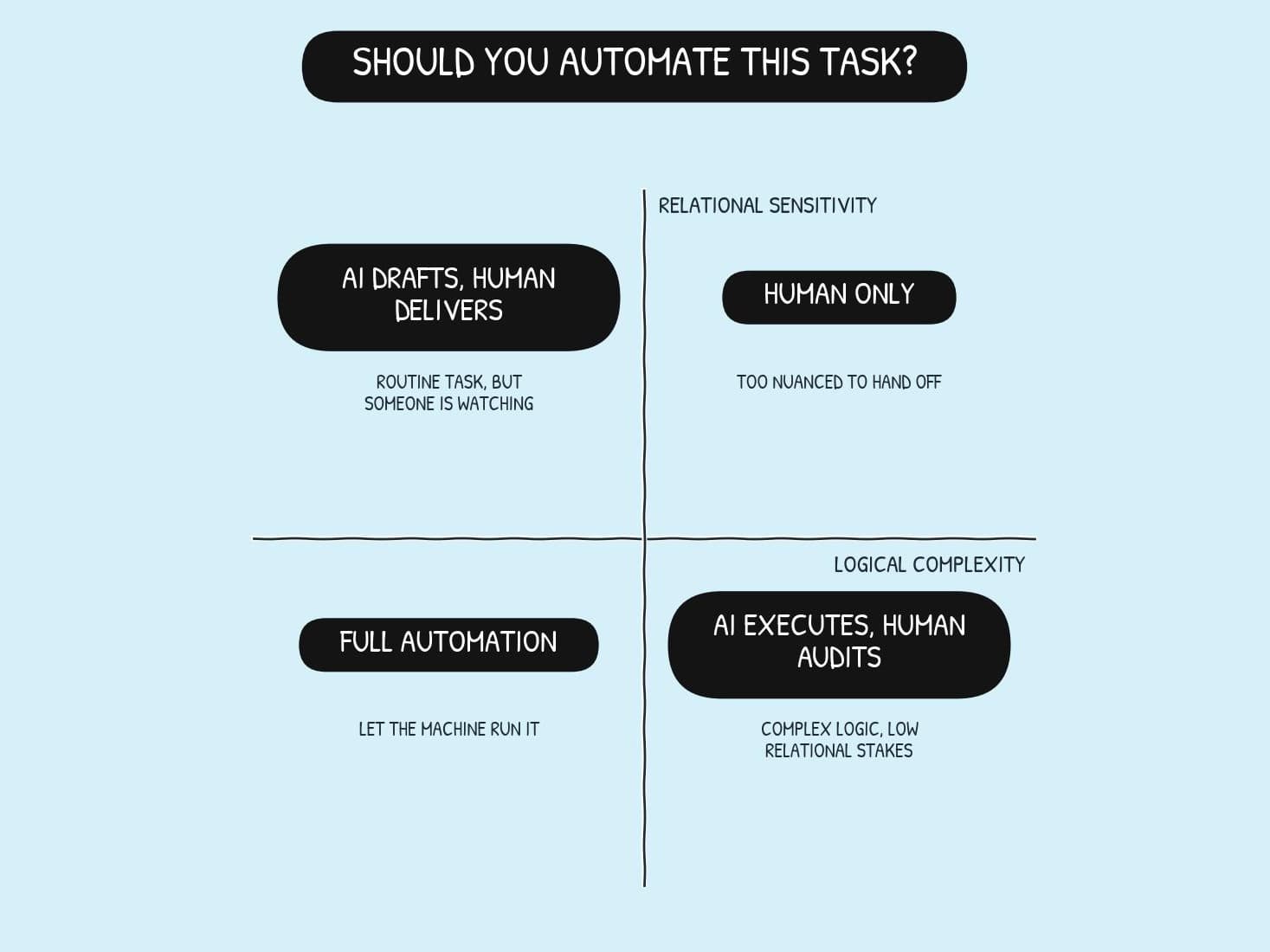
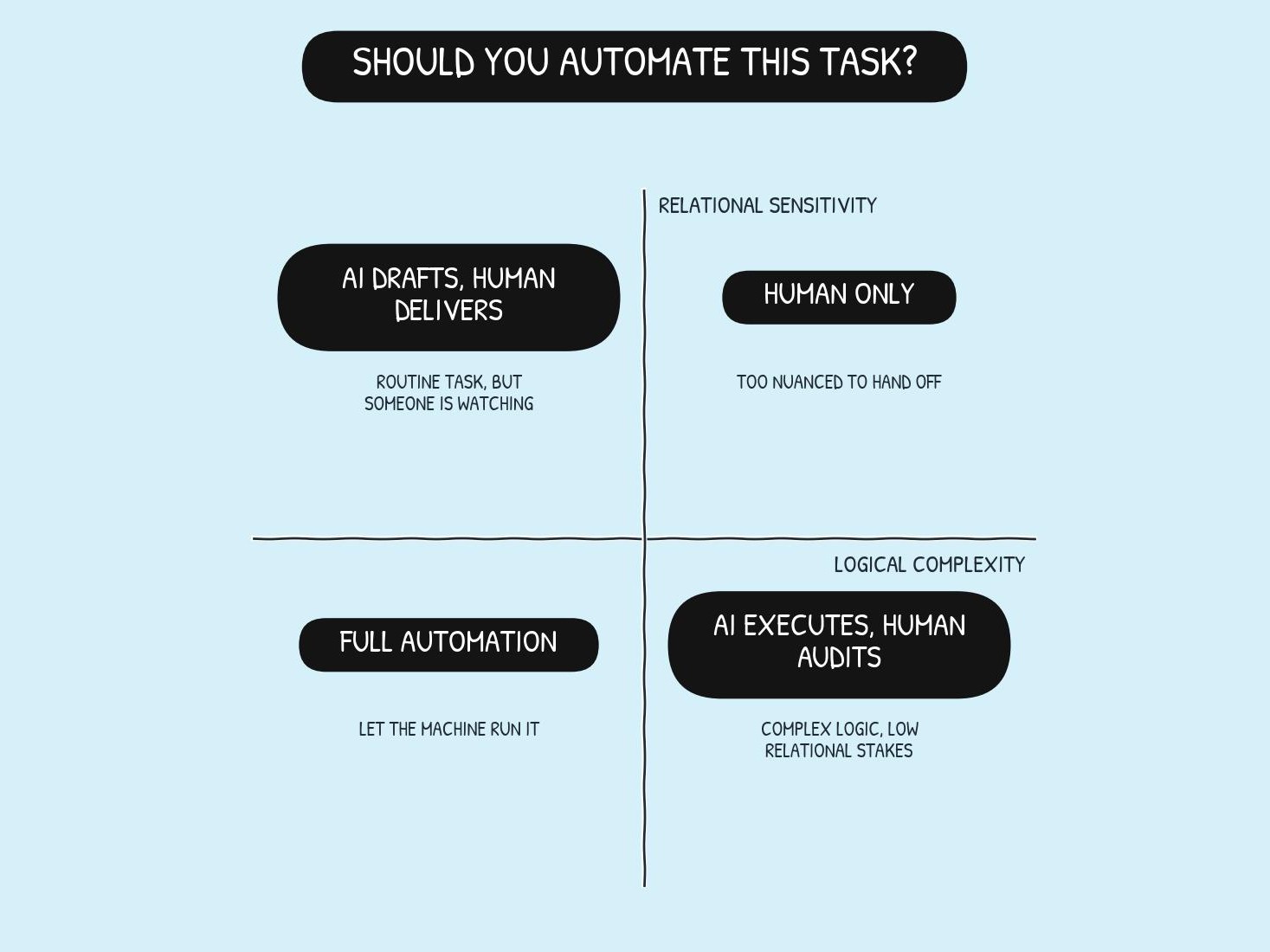
- Cognition. The logical weight of a task: how complex the decision, how severe the consequence of getting it wrong, how much external context it needs, how much expertise it demands.
- Empathy. The human weight: the emotional stakes, the effect on a relationship, how personalized it must be, how sensitive the communication is.
Plot any task on that grid, the one above, and the right operating model stops being a matter of taste. A low-cognition, low-empathy task, routine data entry, is automated outright. High cognition, low empathy, a gnarly but impersonal reconciliation, becomes AI executes, human audits. Low cognition, high empathy, the message that recognizes someone's work or the difficult piece of feedback, becomes AI drafts, human delivers, so the efficiency is captured but the human touch is never amputated. High on both, a real negotiation or a sensitive judgment call, stays human, with AI in support.
“The machine stops telling you only if a task can be automated. It tells you whether it should be.”
Then the system does the part I find most interesting. It does not just label tasks. It restructures the whole process around those labels, applying a library of patterns to turn a linear, human-paced sequence into something agent-native, and it generates more than one future-state design so leaders can choose their trade-off rather than inherit one.
This is what I mean when I say Reimagination, the R in the RADAR framework I use for enterprise AI. Reimagination is not digitizing the old workflow faster. It is redesigning how work is done so that humans and agents share the load by design, and the parts that should remain human are protected on purpose, not by accident.
Why give it away
Here is what twenty years around intellectual property actually taught me, and it is not what the field advertises.
The most valuable ideas are not the ones you fence off. They are the ones that become the default way people work. A patent gives you the right to exclude. But some ideas are worth more as a standard than as a monopoly, and human-centric AI deployment is one of them. You do not earn the right to define how the world automates work with empathy by locking the method in a vault and licensing it. You earn it by writing it down clearly, putting it in the commons, and being the person it traces back to.
A defensive publication does something quietly powerful: it makes an idea permanently un-ownable. No one, including us, can ever patent it. It belongs to everyone now. For most people that sounds like forfeiting value. Having spent years valuing exactly these instruments, I can tell you it is the opposite. It is choosing influence over rent. Standard-setting over toll-collecting.
“The version of me that scored patents would have asked who should own this. The version writing this decided the better question was who should be free to build on it.”
That is not a reversal of my career. It is its conclusion. Read the publication, and build something with it. That is what it is there for.
Co-authored with Hariprasad Rengarajan. Published in the Technical Disclosure Commons, Defensive Publications Series, May 2026.
Prefer slides? View the deck, download the PDF, or get it for Google Slides (PPTX).
Email this as a LinkedIn pack
Get a feed-ready LinkedIn post (under the 3,000-character cap), a long-form LinkedIn article version, the hero image, and an editable document version of the full essay, delivered to your inbox. Ready to post.
Related Insights
Read the publication, or score your own work
The full method is in the public domain. The RADAR Diagnostic tells you whether your AI initiatives are reimagining the work or just paving the cowpath.