Three organs of the adaptive org. Purpose · Metabolism · Immunity.
Metabolism without immunity is autoimmune. Immunity without purpose is just resistance to change.
A follow-up to Organizational Metabolism. Fiona Cicconi named the missing organ: retiring a workflow can feel like retiring an identity. Her follow-up question pulled out the layer underneath: Purpose as the operating system, the third organ. Without Purpose, Metabolism is churn and Immunity is just resistance to change. With it, both have something to serve.
Where this paper came from, and what evolved it
A week after Organizational Metabolism circulated, Fiona Cicconi (Chief People Officer at Alphabet) named the missing organ. The framework that follows is hers; the diagnostic instrument and intervention scaffolding around it are mine, as second author.
“While the structural roadmap is brilliant, we can't ignore the ‘human immune system.’ Retiring a workflow can feel like retiring an identity. For an organization to truly become Adaptive, we have to figure out how to build the psychological safety that allows teams to dismantle their own processes without fearing for their future.”
The framework that followed (five dimensions, five named pathologies, a transformation stack) was the answer to that prompt. After reading it, Fiona asked the follow-up question that produced the Purpose layer.
“How do we incorporate Purpose as a central part of the framework and the thinking?”
The short answer: Purpose isn't a sixth dimension. It's the operating system beneath the five: the signal that tells the immune system what counts as a real threat (vs. just change). Without it, the immune system fires on everything because it can't tell the difference. Naming the operating system, and naming Purpose as one of three organs of the adaptive org, is the architectural move this version makes.
Three organs of the adaptive org
The adaptive org has three organs, not two. Each is necessary. None is sufficient. Without Purpose, Metabolism is churn and Immunity is reflex. EMI is the half of the system that decides whether change is absorbed; Purpose is the layer beneath that decides what counts as renewal versus threat in the first place.
Purpose
What the org is protecting and why. The operating system beneath structure and immunity. Tested by Phase 0: the Purpose Audit and Rediscovery diagnostic.
Without it: drift. Movement and reaction with no direction. Pathology: Purpose Fog.
Metabolism (OMI)
The org's ability to retire workflows, redesign structures, redeploy people. Measured by the OMI score.
Without it: stagnation. Obsolete workflows immortalize; the org freezes.
Immunity (EMI)
Whether the org's response to retirement is renewal or rejection. Measured across five dimensions.
Without it: autoimmunity. Healthy change attacked as threat.
Tasks change. Purpose persists.
“The purpose of your job, and the tasks and tools that you use to do your job, are related, not the same.”
AI eats tasks. The work that survives is purpose. Which is why a framework about absorbing AI structurally cannot be silent on the layer beneath. The earlier version of EMI named the immune system; this version names the Purpose operating system the immune system rests on.
Purpose Audit and Rediscovery
A team that doesn't know its Purpose can score “high” on every EMI dimension and still be in deep trouble, because the team is well-organized around the wrong center of gravity. Phase 0 is the gate. Five questions, anchored to Jensen's distinction. If the team can't articulate Purpose separate from tasks, the move isn't to fix Identity or Closure. It's to stop and run Purpose Rediscovery first.
How the audit works, scoring, and what to do when a team fails →The Same-Breath Principle
“Tell people what to focus on going forward in the same breath as what not to focus on. The retirement of old work and the naming of new work are one sentence, not two memos. The latter without the former is what breaks transformations.”
Humans process loss faster than gain. A retirement memo without the next-focus paragraph lands in a vacuum the team has already filled with fear. The two-step approach (“we'll announce what comes next next quarter”) guarantees autoimmune response. Same-Breath is the discipline of telling both halves at once.
Operationalized, this becomes a People-function review gate. Every retirement memo passes through a 24-hour Same-Breath compliance check before it ships. The single test: does the memo name what the team should focus on next, in the same paragraph, with the same level of specificity, as what they should stop? If yes, ship. If no, return to the author. By the third quarter, leaders draft Same-Breath as a default because the rework is more painful than the discipline.
The most common transformation failure mode isn't “we communicated too little.” It is “we communicated half the message and asked people to be patient about the other half.”
Metabolism without immunity is autoimmune. Immunity without purpose is reflex.
When a team reads a workflow retirement as a threat, the threat is almost never to the org. It is to identity. To expertise. To status. To the group the workflow kept intact. The immune response is rational at the individual scale and destructive at the organizational one.
Most change-management literature treats this response as “resistance” and tries to overcome it. That is the wrong frame. Resistance is a symptom. The underlying system is an immune system doing its job, and its job is to protect the Purpose. If you keep overriding it with decree, you don't get adaptation. You get burnout, quiet quitting, and eventually autoimmune disorder.
The adaptive org has all three organs, and knows which one is failing when the body feels sick.
Five organs of the organizational immune system
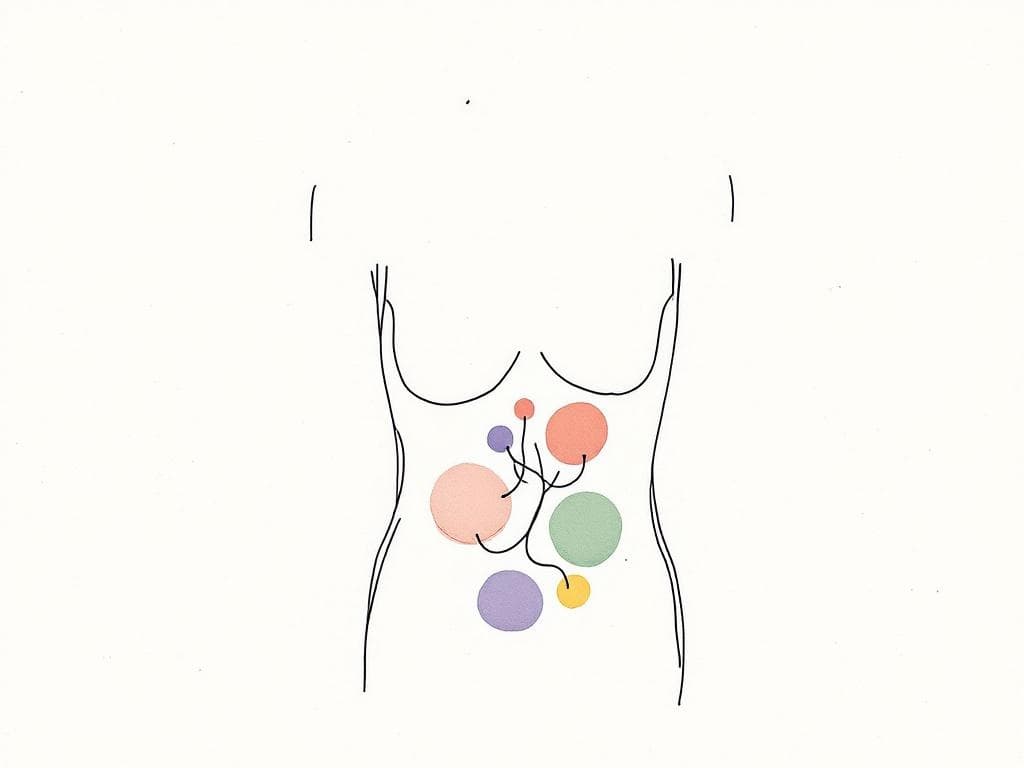
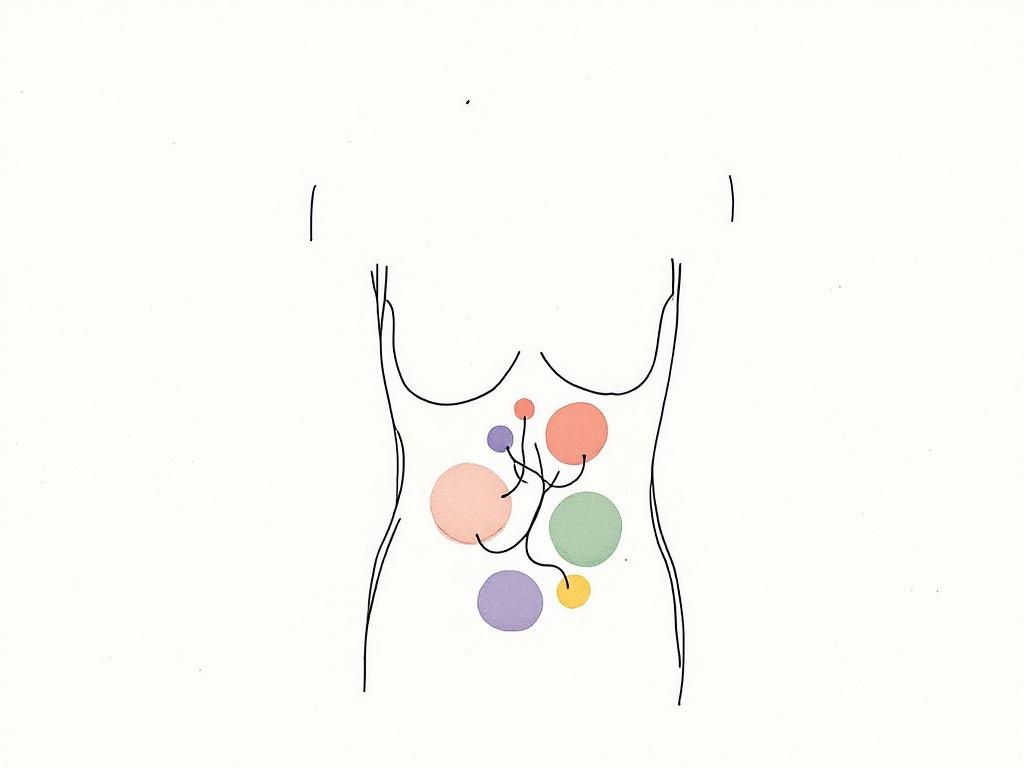
EMI is not a metaphor with five things; it's an anatomy with five organs. Each organ has a healthy state and a named pathology when it fails. The body below is the framework. The matrix that follows is the diagnostic version of the same story.
Five organs, five failure modes. Adaptive Immunity = all five healthy.
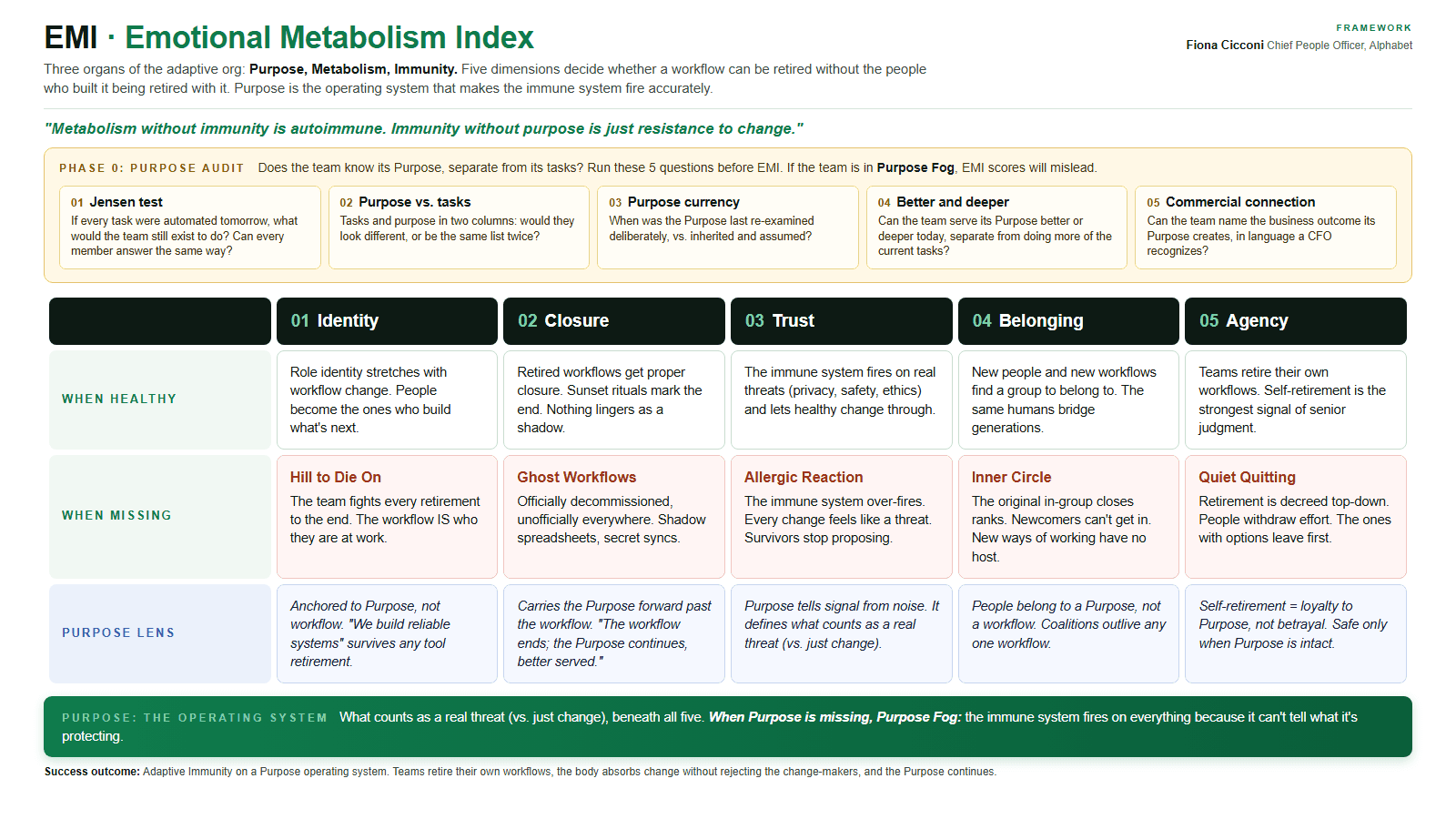
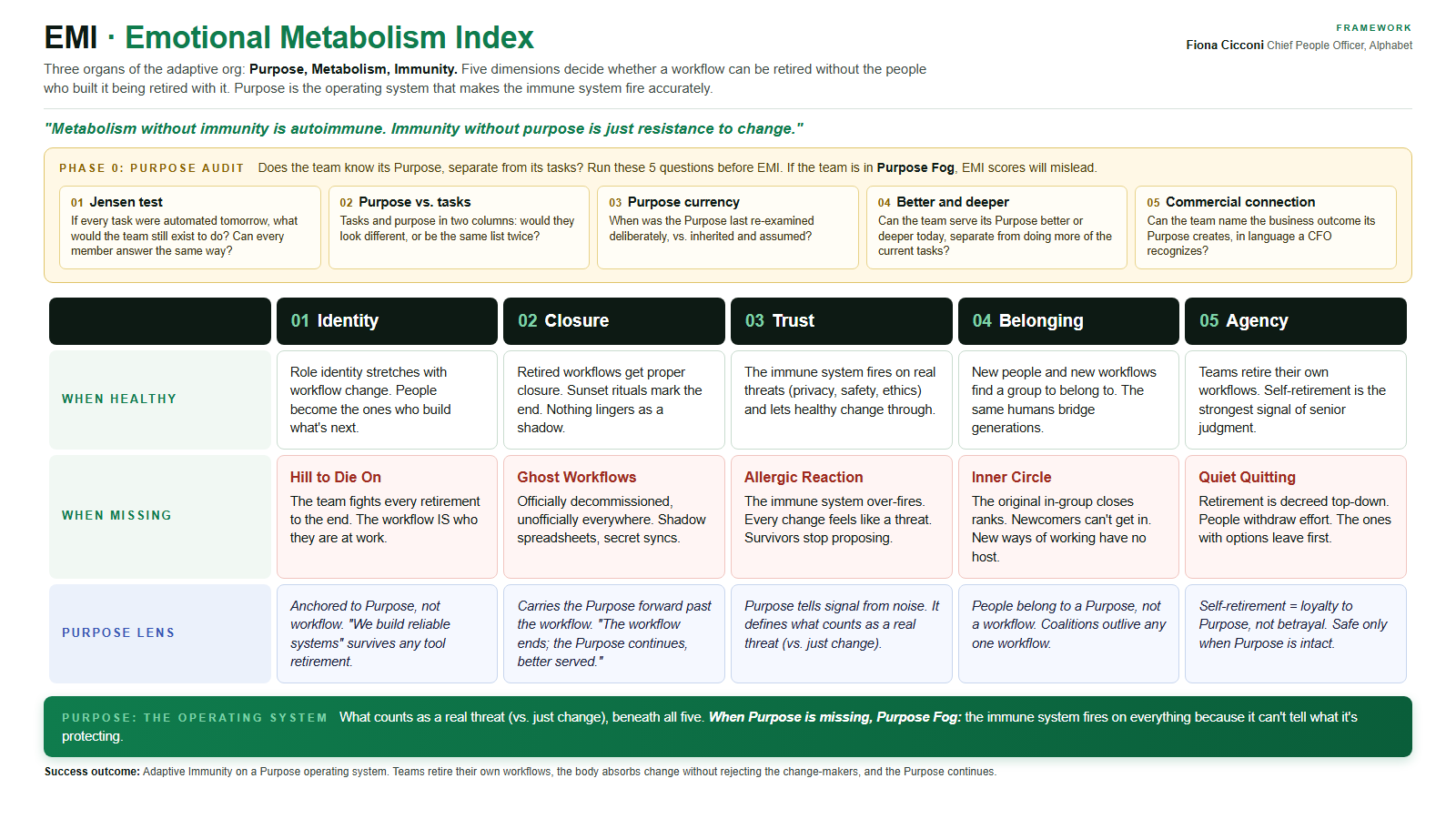
Five dimensions, five pathologies, now read through Purpose
The five dimensions and their named pathologies are unchanged. What's new is the third strip on each card: the Purpose lens. It says how this dimension lives in a team that has Purpose clarity, and why it falls into pathology when Purpose is missing.
The full transformation stack: now five layers
Most frameworks end at the diagnostic. EMI is designed to end at a transformation. Below is the full stack: what is available today, and what is in the next layer of the work. Layer 5 is the new addition: the People-function upgrade EMI requires.
The Diagnostic
Phase 0 (Purpose Audit and Rediscovery) gates the EMI 25-question diagnostic. Five Purpose-clarity items first; if the team passes, proceed to the five dimensions. A composite score from 0 to 100, archetype placement (Brittle → Regenerative), and an action plan scoped to your role and industry.
EMI in Practice
Five pathology-specific intervention artifacts a manager can run on a Tuesday morning. Identity Portability Worksheet, Sunset Audit Checklist, Vaccination-via-Sandbox Playbook, Integration Rituals Guide, Retirement Co-Design Template. Each one self-contained, no consultant required.
Training & Enablement
Three audiences, three different products. ICs get a 20-minute self-paced module; managers get a half-day workshop with role-plays per pathology; POps and transformation leads get a train-the-trainer certification. Currently delivered as a coaching engagement; self-serve modules in development.
Pilot Blueprint
An 8-week pilot, pre-designed. Named workflow, named cohort, week-by-week timeline, lead and lag indicators, exit criteria, three-failure pre-mortem with mitigations, comms plan, Phase 2 with named tracks. Now with Phase 0 prerequisite and Same-Breath review at week 4.
Four immune profiles of organizations
Not every org has the same immune problem. There are four profiles, and the treatment for each is different. Cross metabolic rate (the OMI score) with immune adaptiveness (the EMI score), all sitting on the Purpose operating system, and every org lands in one of these four.
Absorbs every change without learning. What looks like agility is chaos.
No antibodies, no memory, no adaptation. The same workflow pattern gets reinvented every 18 months because nothing holds. High metabolism with no immunity looks adaptive from the outside and feels exhausting from the inside.
Attacks healthy change. The body can no longer tell a threat to the org from a threat to a job.
Most legacy enterprises. Every new tool, process, or reorg triggers a full immune response. Change-management literature calls this 'resistance' and tries to overcome it. That is the wrong frame. Resistance is a symptom. The underlying system is an immune system doing its job, and if you keep overriding it with decree, you get burnout, quiet quitting, and eventually organ failure.
Over-responds to low-risk change. A prestige pathology.
Elite firms where identity is fused with 'the way we do things here.' A surface scratch triggers anaphylaxis. Often co-exists with high structural metabolism: the org can move fast on anything that doesn't touch the core of how it sees itself, and freezes completely when it does.
Tolerates renewal. Mounts response only against genuine threats.
The target state. Privacy, safety, ethics, strategic mis-fit: these trigger response. Healthy workflow retirement does not. Rare enough that most leaders have never worked in one. Also the only profile in which high metabolism actually produces high absorption.
AI is uniquely threatening, and uniquely Purpose-revealing
AI does not threaten the task layer. It threatens the expertise layer. “My code” becoming “Claude's code” reads as role end, not tool change. A senior engineer whose review workflow gets absorbed by an agent is not losing a process; they are losing the practice their identity is built on.
This is also why AI is the single most under-appreciated Purpose-revealer of our time. As tasks dissolve, what's left visible is Purpose, or the absence of it. Teams that never had to articulate Purpose because tasks did the work for them now have to. The framework isn't replacing change management; it's naming the operating system AI is exposing.
You cannot solve AI absorption without solving the immune response it triggers. You cannot solve the immune response without naming the Purpose the immune system is protecting.
Measure your organizational immune system
Phase 0 (5 questions) plus EMI (25 questions). About 6 minutes. You get a Purpose-clarity read first, then an EMI score from 0 to 100, your archetype placement (Brittle → Regenerative), and an action plan scoped to your role and industry.
Framework: Fiona Cicconi · Chief People Officer, Alphabet. Instrument & scaffolding: Rahul Jindal, second author. The Purpose layer was drafted April 2026 in response to Fiona's follow-up question.